
Elevance Health reported second quarter 2026 results this morning. Adjusted EPS of $7.45 against a $6.21 consensus, a 20% beat. Revenue of $49.8 billion, ahead by $1.17 billion. Full-year guidance raised. Operating cash flow guidance raised.
The stock fell 10.58% before rebounding slightly and closing down 8.54%, at $390.33.
That combination reads like a market being irrational until you open the actual earnings release, at which point it reads like a market doing arithmetic. Adjusted EPS did beat by 20%. It also fell 15.7% from a year ago. Operating gain across the reportable segments fell 27.3%. The health insurance business, the part of Elevance that sells health insurance, earned 42.6% less than it did last June.
The beat is real. It is a beat against a consensus that had already marked the quarter down hard, and it was manufactured below the operating line. The ACA book is doing something specific and temporary, and the single most revealing thing about the call is a word that nobody, on either side of the Q&A, said even once.
Source: Elevance Health 2Q 2026 Earnings Release, July 15, 2026; quotes and the $26 baseline from the Elevance Health Q2 2026 earnings call, July 15, 2026 (transcript via Investing.com)
The beat that is a 16% decline
Start with the $7.45, because $1.24 of upside on a $6.21 base is a genuinely enormous number and it is also two different things at once.
Against the street, it is a 20% beat. Against last June's $8.84, it is a 15.7% decline. Both are true, and only one of them was in the headlines this morning. The consensus was not a neutral yardstick; it was an expectation that Elevance would earn about 30% less than it did a year ago, and Elevance earned about 16% less instead.
Now take the $0.80 out. It is a below-the-line benefit, which CFO Mark Kaye attributed primarily to valuation adjustments inside net investment income, and you can see it plainly in the income statement: net investment income rose 44.9% year over year, from $486 million to $704 million. Investment marks are real money. They are not the health insurance business, they do not recur on any schedule you can underwrite, and no analyst has them in a model.
Strip it and the quarter earned $6.65, a 7.1% beat. That is the number that is about operations, and even it makes things look better than they were, because operations did not have a 7% quarter. Operations had this quarter:
Health Benefits operating gain went from $1,560 million to $896 million. Down 42.6%, on revenue that grew 2.7%. Segment operating margin went from 3.8% to 2.1%. Company-wide adjusted operating margin went from 5.0% to 3.6%.
| Metric | Q2 2026 | Q2 2025 | vs. last year | vs. consensus |
|---|---|---|---|---|
| Adjusted EPS | $7.45 | $8.84 | -15.7% | +$1.24 (+20.0%) |
| Adjusted EPS excluding the $0.80 | $6.65 | — | — | +$0.44 (+7.1%) |
| GAAP diluted EPS | $6.71 | $7.72 | -13.1% | — |
| Segment operating gain | $1,763M | $2,425M | -27.3% | — |
| Health Benefits operating gain | $896M | $1,560M | -42.6% | — |
| Adjusted operating margin | 3.6% | 5.0% | -140 bp | — |
| Net investment income | $704M | $486M | +44.9% | — |
| Operating revenue | $49.8B | $49.4B | +0.8% | +2.4% |
| Premium revenue | $41,279M | $41,271M | Flat | — |
| Benefit expense ratio | 89.7% | 88.9% | +80 bp | — |
| Operating expense ratio | 11.1% | 10.1% | +100 bp | — |
| Medical membership | 44,949k | 45,621k | -1.5% | — |
| Days in claims payable | 45.4 | 42.5 | +2.9 days | -1.2 days vs Q1 |
| Share price | $390.33 close | $426.79 prior close | -8.54% on the day | -10.58% at the premarket low |
Read the ratios at the bottom of that table, because they are the whole quarter in two lines. The benefit expense ratio rose 80 basis points to 89.7%, which the company attributes to elevated medical cost trend in its Government businesses, partially offset by improved performance in Individual ACA. The operating expense ratio rose 100 basis points to 11.1%, driven by the targeted investments. Both directions cost margin. Premium revenue, the actual insurance top line, was flat: $41,279 million against $41,271 million.
Then look at what happens to the $0.80. It gets spent.
That is the move that reframes the raise. Guidance goes up to at least $27.00, and the mechanism funding a chunk of that raise is an investment gain that is immediately consumed by one-time spending in the back half. The company gets a higher headline number and never has to defend it as run-rate, because by the time 2027 starts, the gain and the spending have both left the building.
The 2027 number the market actually traded on
| Item | Guidance | What it means |
|---|---|---|
| FY2026 GAAP diluted EPS | At least $20.10 | Raised |
| FY2026 adjusted diluted EPS | At least $27.00 | Raised. $6.90 of add-backs sit between the two, including $4.27 for the CMS notice |
| FY2026 operating cash flow | At least $6.0B | Raised, but the first half alone produced $6.25B |
| Q3 2026 adjusted EPS | ~17% of full year | Implies roughly $4.59 |
| 2027 earnings baseline | At least $26.00 | Management calls this a "higher" baseline. It is below the $27 headline because the $27 is not run-rate |
| 2027 adjusted EPS growth | At least 12% | Off the $26 baseline, not off $27 |
| 2027 implied adjusted EPS | ~$29.12 | The number the market actually re-priced against |
| Medicaid operating margin, FY2026 | ~-1.75% | Unchanged. Described as the trough |
| Medicare Advantage operating margin, FY2026 | At least 2% | On track, on a book that shrank 15.9% year over year |
| Individual ACA members, year-end 2026 | At least 1 million | From 1,317k at June 30. Implies losing up to another ~300k |
Here is where the drawdown comes from, and it requires doing arithmetic the company did not print.
2026 guidance: at least $27.00 adjusted, at least $20.10 on a GAAP basis. The 2027 baseline for modeling: at least $26.00, which Kaye explicitly called a higher baseline, and he is right, it was raised. But it sits a dollar below the 2026 headline, for the good reason that the 2026 headline is not a clean number. Growth of "at least 12%" then runs off the $26.00, not off the $27.00.
$26.00 times 1.12 is $29.12.
That is the 2027 figure this call actually communicated. Whether that is good or bad depends entirely on where the sell side already was, and an 8.5% drawdown suggests they were higher. The company did not cut anything. It just showed its work, and the work implied a smaller 2027 than the $27 headline invited people to compound from.
Two more things in that table are worth pausing on. Third quarter guidance of roughly 17% of the full year implies about $4.59, a steep step down from a first half that just printed $7.45 in Q2 alone. And the operating cash flow guidance, raised to "at least $6.0 billion," is a number the company already passed in the first half, which produced $6.245 billion. Management flagged that Q2 cash reflects the timing of a state Medicaid pass-through payment. Timing reverses. A full-year cash guide that sits below the half-year actual is telling you the back half gives some back.
What management said
Gail Boudreaux President and CEO HedgedAs expected, the higher mix of bronze plans creates more pronounced seasonality, we are not extrapolating early year favorability.
What it meansThe single most important sentence on the call for anyone who covers the exchanges. Bronze plans carry a roughly $6,900 median deductible, so their claims arrive late in the year. A bronze-heavy book looks profitable in Q2 by construction. Boudreaux is telling you the ACA favorability is a calendar artifact and will unwind in the back half.
Felicia Norwood Chief Health Benefits Officer ConfidentWe've been very pleased with how we've seen the marketplace shift in terms of bronze plans.
What it meansThe buy-down from silver to bronze is being reported as a win. From a margin seat it is: bronze shifts risk onto the member. The median bronze deductible on HealthCare.gov is $6,900, and cost-sharing reductions only attach to silver, so 3.8 million people lost their CSR by moving. The carrier and the consumer are reading the identical number in opposite directions.
Felicia Norwood Chief Health Benefits Officer HedgedWe are going to be very focused on making sure that we are achieving the sustainable margin through very disciplined market-specific pricing that will reflect the cost trend and certainly the evolving morbidity.
What it means"Evolving morbidity" is doing a great deal of work in that sentence. It is the closest anyone on this call comes to naming what happened when the enhanced subsidies expired. Market-specific pricing means the states where the pool got worse will be priced for it, or exited.
Mark Kaye Chief Financial Officer HedgedWe are prudently reestablishing the majority of the prior year favorability in our current year risk adjustment accrual given current market dynamics, member mix, and claims experience that is still maturing.
What it meansFinal 2025 risk adjustment came in better than they had booked. Rather than bank the gain, they are putting most of it straight back into the 2026 accrual. You do that when you think the pool you are pricing is not the pool you priced. "Member mix" is bronze; "market dynamics" is the subsidy cliff.
Mark Kaye Chief Financial Officer WarningMember retention remains modestly ahead of our expectations, and we now expect to end 2026 with at least 1 million individual ACA members.
What it meansThe release puts a number on it: Individual fell from 1,424,000 at March 31 to 1,317,000 at June 30, down 107,000 in a single quarter. Guiding to "at least 1 million" by December implies losing up to another 300,000. Retention is "ahead of expectations" only because the plan assumed a melt.
Gail Boudreaux President and CEO HedgedOur 2027 bids were developed with the same discipline, reflecting a prudent view of cost trend, continued focus on margin improvement, and stability in the benefits that members value most.
What it meansMedicare Advantage margin is being rebuilt out of benefit design and plan exits: the book is down 358,000 members, or 15.9%, year over year. "Stability in the benefits that members value most" is a promise about the headline benefits, not the whole package. Margin first, growth later, for a third straight bid cycle.
Mark Kaye Chief Financial Officer WarningImportantly, we intend to use this non-recurring benefit to fund one-time investments in the second half of the year that advance the capabilities Gail discussed.
What it meansThe $0.80 never touches shareholders. An investment gain arrives and is spent in the same breath, which conveniently means the raised full-year number does not have to be defended as run-rate. Net investment income rose 44.9% year over year, to $704 million, while segment operating gain fell 27.3%.
Gail Boudreaux President and CEO WarningAs we continue our assessment, we expect to exit additional Medicaid markets over the next 12 to 18 months where we do not see a path to sustainable performance.
What it meansD.C. is already agreed. More are coming. A -1.75% margin is not a rate problem you wait out, it is a portfolio you shrink, and states losing a national plan mid-cycle inherit the members.
What it means for the ACA exchanges
This is the part I care about most, because I spent last night inside the CMS open enrollment files and Elevance just described the same phenomenon from the other side of the ledger.
Elevance's individual ACA business had a favorable quarter. This is not my inference: the release says the benefit expense ratio rose 80 basis points on elevated Government cost trend, "partially offset by improved performance in Individual ACA compared to the prior year." In a quarter where the insurance segment's operating gain fell 42.6%, ACA was one of the few things pushing the other way.
Boudreaux told you exactly why, and then told you not to believe it: the higher mix of bronze plans creates more pronounced seasonality, and they are not extrapolating early year favorability.
Here is the mix she is talking about, from the CMS files rather than from Elevance:
Silver selections fell 28% for 2026. Bronze rose 25.9%. That is the buy-down that happened when the enhanced subsidies expired and net premiums jumped 58%.
Now think about what a bronze plan does to a carrier's calendar. The median bronze deductible on HealthCare.gov is $6,900. A bronze member spends the first several months of the year paying their own claims, and the plan pays almost nothing. Then the deductible fills, and in the back half the carrier starts writing checks. A book that shifts ten points of mix from silver to bronze will look more profitable in Q2 and less profitable in Q4 with no change whatsoever in underlying health.
So Elevance's ACA favorability this quarter is, substantially, a calendar effect created by a policy change. Management knows it, said so, and is refusing to bank it. That is the correct call and it is also a warning about Q4.
The second signal is membership, and the release is far more specific than the call was. Kaye said retention is "modestly ahead" of expectations. Here is what that looks like in the membership table: Individual went from 1,424,000 at March 31 to 1,317,000 at June 30. That is 107,000 people, 7.5% of the book, gone in a single quarter, in the quarter after open enrollment ended. And the guide is to finish the year at "at least 1 million," which from 1,317,000 leaves room to lose another 300,000.
That is not churn. That is a melt, and CMS can tell you it is not an Elevance problem:
Only 82.9% of 2026 plan selections nationally turned into paid coverage by February, the worst effectuation rate since 2017. Effectuated enrollment fell 12.0% year over year against a 4.9% drop in plan selections. Elevance's "anticipated attrition" and CMS's collapsed effectuation rate are the same people: enrollees who picked a plan when the price was $0 and stopped paying when it was not.
There is a third number here that I did not expect to find, and it is the cleanest corroboration in either document. Individual segment revenue rose 16.8% year over year, to $2.72 billion, while Individual membership over that same year-over-year window fell 2.3%, from 1,348,000 to 1,317,000. (The 7.5% drop above is the sequential one, against March. Most of this year's melt happened inside 2026, so the year-over-year comparison understates it.) Divide revenue by members and premium per member is up roughly 20%.
The CMS files say the national average gross premium went from $619 to $741 for 2026. That is +19.7%.
Two completely independent sources, one a federal enrollment file and one a corporate income statement, land on the same number. That is what the subsidy expiration did to the price of an exchange plan, and it is why Elevance's individual book can shed 107,000 members in a quarter and still grow revenue 17%. Fewer people, each paying a fifth more.
Third: risk adjustment. Final 2025 results came in favorable to what Elevance had booked, and instead of taking the gain, they put most of it back into the 2026 accrual, citing market dynamics, member mix, and immature claims. A carrier that believed its 2026 pool resembled its 2025 pool would not do that.
Add it up and Elevance's ACA position reads like this: the book is smaller, more of what is left sits in bronze plans that pay out later in the year, the seasonality is making the quarter look better than the year will, the morbidity is "evolving," and the reserving posture assumes the surprises come in worse rather than better. Felicia Norwood said 2027 pricing will reflect "the evolving morbidity" through "disciplined market-specific pricing." Market-specific is the operative word. My county-level work says the pool did not deteriorate uniformly; it deteriorated hardest where enrollees were poorest, and those are precisely the markets that get repriced or dropped.
What it means for Medicare Advantage
Presented as the cleanest part of the quarter. It is cleaner than Medicaid. It is not clean.
Medicare Advantage is on track for an operating margin of at least 2%, which management attributes to deliberate repositioning: disciplined plan design, a more focused mix of D-SNP and HMO products, favorable claims experience, and care management. In plain terms, they shrank and narrowed the book on purpose and it is working.
The release puts the size of "shrank" in print:
| Business | Jun 30, 2026 | Mar 31, 2026 | Jun 30, 2025 | vs. Q1 | vs. last year |
|---|---|---|---|---|---|
| Individual (incl. ACA) | 1,317 | 1,424 | 1,348 | -7.5% | -2.3% |
| Medicare Advantage | 1,897 | 1,899 | 2,255 | -0.1% | -15.9% |
| Medicare Supplement | 893 | 888 | 874 | 0.6% | 2.2% |
| Medicaid | 8,358 | 8,456 | 8,733 | -1.2% | -4.3% |
| Commercial risk-based | 4,734 | 4,863 | 4,963 | -2.7% | -4.6% |
| Commercial fee-based | 27,513 | 27,749 | 27,154 | -0.9% | 1.3% |
| Federal Employee Program | 1,554 | 1,563 | 1,642 | -0.6% | -5.4% |
| Total medical membership | 44,949 | 45,418 | 45,621 | -1% | -1.5% |
Medicare Advantage membership fell 15.9% year over year, from 2,255,000 to 1,897,000. That is 358,000 seniors who are no longer Elevance members, and Medicare segment revenue is down 4.2% because of it. This is what a 2% margin costs. It is not a recovery, it is a retreat that is working as designed.
The forward-looking sentence is about the 2027 bids, developed with "a prudent view of cost trend, continued focus on margin improvement, and stability in the benefits that members value most." Parse that last clause. It is not a promise of better benefits. It is a promise that the benefits members notice will not get visibly worse, which is a different and much cheaper commitment. This is Elevance's third consecutive bid cycle prioritizing margin over membership. Several of its larger competitors have made the same trade over the same stretch, but it is not a universal industry posture: plenty of carriers are still buying share, which is precisely why Elevance can shed 358,000 members and the national Medicare Advantage total keeps climbing.
And then there is the thing that never came up on the call at all, which you only find if you read to the footnotes of the GAAP reconciliation.
Elevance has accrued $935 million as its "current best estimate of the identified potential exposure for certain historical Medicare Advantage risk adjustment data related to the CMS notice to the Company dated February 27, 2026." That is $4.27 per share, taken in the first half, parked in Corporate & Other, and added straight back to get from $20.10 of GAAP earnings to $27.00 of adjusted earnings. It is the single largest adjusting item in the full-year bridge, bigger than intangible amortization and financial instrument losses combined.
A CMS notice about historical risk adjustment data is the polite name for an audit finding on how a plan coded its members. Nearly a billion dollars of accrued exposure is not a rounding error, and "current best estimate" is doing the same work "evolving morbidity" did in the ACA discussion. For seniors, the read-through is another year of stable-to-thinner supplemental benefits and continued county-level exits. For anyone modeling MA into 2027, a 2% margin achieved on a book that shrank 16%, with a $935 million coding exposure accrued against it, is not a franchise being harvested. It is one being defended.
What it means for Medicaid
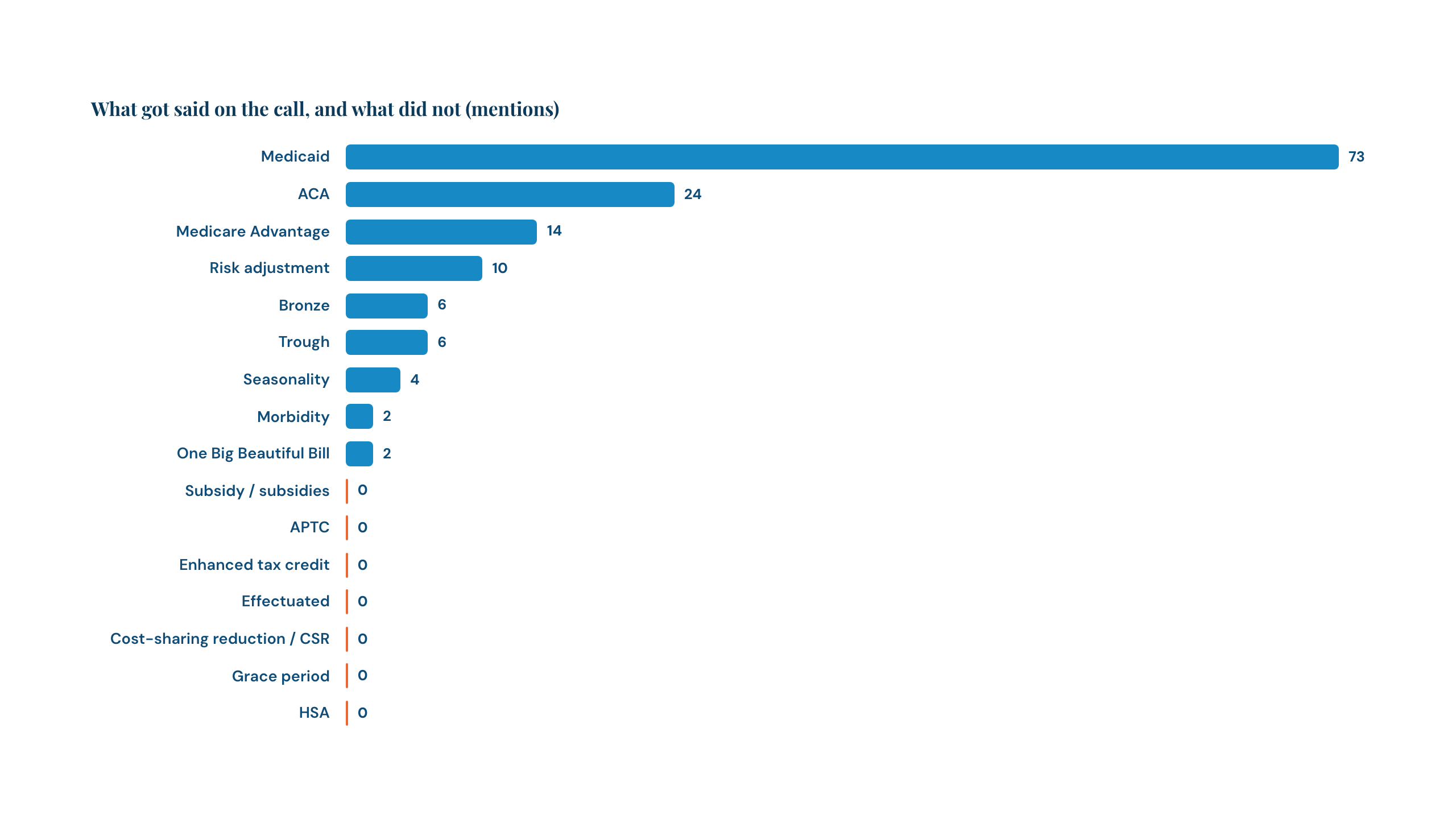
Medicaid is the reason nobody on the call wanted to talk about anything else. It came up 73 times.
The full-year operating margin outlook stayed at roughly -1.75%. Management calls 2026 the trough. Cost pressure is concentrated in behavioral health, emergency department use, outpatient surgery, and specialty pharmacy. July rate updates landed in the mid-to-upper single digits and were described as constructive and modestly better than expected.
The important nuance, and Kaye was careful here, is that this is not a repeat of the post-pandemic unwind. They are not seeing a new stepwise acuity reset; they are seeing rising utilization among the members who remain. That is a slower, grindier problem than a one-time selection shock, and it is harder to price out of.
Which is why the real news is the portfolio. Elevance has agreed to exit the D.C. Medicaid market and expects to exit additional Medicaid markets over the next 12 to 18 months where it does not see a path to sustainable performance. A -1.75% margin is not something you wait out. It is something you shrink.
Looking to 2027, Kaye flagged incremental acuity pressure from the One Big Beautiful Bill Act's community engagement and eligibility verification requirements, while explicitly saying he does not view it as a broad-based reset comparable to the PHE unwind. Translation: work requirements will push healthier people off the rolls, which makes the remaining pool sicker, but gradually rather than all at once.
What they did not say
I counted every term on the call. This is the chart I would put in front of anyone who wants to understand how carriers talk about policy.
"Medicaid" was said 73 times. "ACA" 24 times. "Bronze" 6 times. "Morbidity" twice.
"Subsidy" was said zero times. So was "APTC." So was "enhanced tax credit." So was "cost-sharing reduction." So was "effectuated." So was "grace period."
The largest change to the individual health insurance market since the ACA was written took effect on January 1. Two quarters in, with the effects showing up in Elevance's own membership table and benefit expense ratio, nobody on this call, not one executive and not one of the fifteen analysts who asked a question, named it out loud.
They described it constantly. The bronze mix is the subsidy expiration. The seasonality is the subsidy expiration. The attrition is the subsidy expiration. The evolving morbidity is the subsidy expiration. The reestablished risk adjustment accrual is the subsidy expiration. Every symptom got discussed in detail and the cause never got a name.
I do not think that is a conspiracy. I think it is what happens when a policy becomes an operating condition. You stop calling it policy and start calling it mix. But it is worth noticing, because "mix shift toward bronze" sounds like a market doing normal things, and "four million people picked a plan and never paid for it" sounds like something else, and those are the same sentence.
What to watch
Q4, not Q3. If the bronze seasonality thesis is right, ACA margin should deteriorate through the back half as deductibles fill, and Q4 is where a bronze-heavy book gets expensive. Management has pre-announced this. If Q4 ACA margin holds up anyway, then the morbidity of the remaining pool is genuinely better than priced, and 2027 pricing is too conservative across the industry.
The 1 million floor. Individual sat at 1,317,000 on June 30 and the guide is "at least 1 million" by December. If they land near 1.3 million, the melt stopped in Q2. If they land near 1.0 million, another 300,000 people lost coverage over a summer, the CMS effectuated series keeps sliding, and the whole industry's 2027 individual pricing is built on a shrinking, sicker base.
The $935 million. That accrual is a "current best estimate" against a CMS notice on historical Medicare Advantage risk adjustment data. Estimates move. If it grows, it stops being an adjusting item and starts being the story, and it lands on a book that has already shed 16% of its members.
Which Medicaid states. D.C. is announced. The next exits over 12 to 18 months will tell you whether this is pruning or retreat, and every exit hands a state a mid-cycle transition problem.
Whether anyone says the word. Q3 call is in October, three weeks before an election, with 2027 rates filed and the effectuated data by then covering most of the year. If "subsidy" is still absent from the transcript then, that is a choice.
Sources: all company financials are from the Elevance Health 2Q 2026 Earnings Release (July 15, 2026), including the income statement, membership table, reportable segment details, and GAAP reconciliation. Quotes, the $26.00 baseline, the Q3 phasing, and the Medicaid and Medicare Advantage margin targets come from the Q2 2026 earnings call transcript (Investing.com, July 15, 2026); quotes are verbatim and attributed to the executive who said them. Term counts are case-insensitive matches across the full transcript text including analyst questions. The consensus figures ($6.21 EPS, $48.63B revenue) and the share price reaction are as reported by Investing.com. Implied 2027 EPS ($29.12), Q3 EPS (about $4.59), adjusted EPS excluding the below-the-line benefit ($6.65), and Individual premium per member are my arithmetic on the company's own inputs, not company-provided figures. Premium per member divides quarterly segment revenue by period-end membership, which is a proxy: members moved during the quarter, so treat it as an order of magnitude rather than a rate. Marketplace metal mix, deductibles, premiums, and effectuation figures are from my own panel of the CMS Marketplace Open Enrollment Period Public Use Files (2015-2026) and the CMS Health Insurance Exchanges Monthly and Annual Effectuated Enrollment files on data.cms.gov. I hold no position in ELV and this is not investment advice.