
Disclosure: I own shares of UnitedHealth Group (UNH). I have no intention of buying or selling any UNH shares in the next 30 days. This is not investment advice.
UnitedHealth Group reported second quarter 2026 results this morning, and the market's first instinct was to love them. Adjusted EPS of $6.38 against a consensus near $4.85, a 31% beat. GAAP EPS of $6.04. Revenue of $112.0 billion. Earnings from operations of $8.0 billion, up 55% year over year. Full-year guidance raised for the second time this year, to $19.50 to $20.00 adjusted. The stock spiked 7.6% premarket to a fresh high of $450.
Then it spent the day thinking better of it. UnitedHealth closed up just 1.20%, a gain of $5.04, having handed back almost the entire premarket pop. That fade is the tell. It is the Elevance quarter in reverse: there the market punished a beat, here it declined to reward one, and in both cases it did the arithmetic underneath the headline and came away less impressed than the print.
After the year UnitedHealth just had, a clean beat is the story, and I do not want to wave it away. This is a company that pulled its guidance, changed its chief executive, and watched its medical costs blow out over the course of 2025. A quarter this far ahead of the street is a real turn.
But three things sit underneath the headline, and none of them were in it. The comparison is against the worst quarter in the company's modern history. The margin was bought by shrinking. And the same release that raised the full-year guide quietly tells you the second half has to be a lot worse than the first. Management said as much on the call, in about that many words.
Source: UnitedHealth Group Second Quarter 2026 Earnings Release, July 16, 2026; quotes from the UnitedHealth Group Q2 2026 earnings call, July 16, 2026. Consensus is a street estimate; the premarket move is third-party.
The beat that is also a comp
Start with the $6.38, because a 31% beat is an enormous number and it is doing two jobs at once.
Against the street's about $4.85, it is a blowout. Against last June's $4.08, it is up 56%, and GAAP earnings are up 61.5%, from $3.74 to $6.04. But Q2 2025 is not a neutral yardstick. It was the quarter the wheels came off: Stephen Hemsley back in the chief executive's chair, full-year guidance withdrawn, and a medical care ratio that spiked to 89.4% as costs the company had underpriced came due. So the year-over-year comparison is real arithmetic off an unreal denominator. Growing 56% is a very different achievement when the base is a trough you dug yourself.
The operating line tells the cleaner version of the story. Earnings from operations went from $5.15 billion to $8.0 billion, up 55.2%, and the medical care ratio fell 270 basis points to 86.7%. That is genuine improvement in the thing that actually broke last year. It also got a one-time lift. The release says the quarter carried $860 million of net favorable medical reserve development. Add that back and the medical care ratio is closer to 87.7%, roughly a point higher. The company is careful to note the majority of that development relates to 2026 dates of service, which is to say they over-reserved earlier this year and released it now, not that a prior year came in clean. Either way it is a number that helped this quarter and does not repeat on a schedule you can underwrite.
| Metric | Q2 2026 | Q2 2025 | vs. last year | vs. consensus |
|---|---|---|---|---|
| Adjusted EPS | $6.38 | $4.08 | +56.4% | +$1.53 (+31.5%) |
| GAAP diluted EPS | $6.04 | $3.74 | +61.5% | — |
| Total revenues | $112.0B | $111.6B | +0.4% | +~$1.1B |
| Earnings from operations | $7,991M | $5,150M | +55.2% | — |
| Medical care ratio | 86.7% | 89.4% | -270 bp | — |
| MCR ex favorable development | ~87.7% | — | — | $860M added back |
| Operating cost ratio | 12.7% | 12.3% | +40 bp | — |
| Net margin | 4.9% | 3.1% | +185 bp | — |
| Days claims payable | 47.0 | 44.5 | +2.5 days | -1.6 vs Q1 |
| Debt-to-capital | 41.2% | 44.1% | -2.9 pt | — |
| People served (UHC) | 48,525k | 50,115k | -3.2% | — |
| Share price | $423.56 close | $418.52 prior close | +1.20% on the day | +7.6% at the premarket high |
Two rows in that table cut the other way. The operating cost ratio rose 40 basis points to 12.7%, which the company attributes to what it calls targeted investments in technology, operations and the community, including roughly $1.5 billion going into artificial intelligence. And days claims payable rose to 47.0 from 44.5 a year ago, which is a reserve build, the opposite of the reserve release that helped the ratio. Balance-sheet repair is real here too: debt-to-capital fell to 41.2% from 44.1%.
Now the segment picture, which is the exact mirror image of the one I ran for Elevance last night. Every Elevance bar pointed down. Every UnitedHealth bar points up.
Optum Health earnings rose 177%, from $429 million to $1.19 billion, and its margin went from 1.7% to 5.1%. That is the business that was supposed to be the problem child a year ago, and it is the single biggest swing in the quarter. UnitedHealthcare operating earnings rose 90%, from $2.08 billion to $3.94 billion, with the margin more than doubling to 4.6%. Optum Insight and Optum Rx grew more modestly, 13.6% and 3.4%. Read the whole chart with the comp in mind: these are enormous percentage gains, and most of them are the sound of a company climbing out of a hole it fell into on the same dates a year earlier.
The margin came from shrinking
Here is the part the growth rates hide. UnitedHealth earned more by covering fewer people.
| Business | Jun 30, 2026 | Mar 31, 2026 | Dec 31, 2025 | Jun 30, 2025 | vs. Q1 | vs. last year |
|---|---|---|---|---|---|---|
| Commercial risk-based | 7,655 | 7,725 | 8,165 | 8,440 | -0.9% | -9.3% |
| Commercial fee-based | 22,265 | 22,340 | 21,485 | 21,530 | -0.3% | 3.4% |
| Total Commercial | 29,920 | 30,065 | 29,650 | 29,970 | -0.5% | -0.2% |
| Medicare Advantage | 7,565 | 7,555 | 8,445 | 8,350 | 0.1% | -9.4% |
| Medicaid | 6,780 | 7,160 | 7,380 | 7,490 | -5.3% | -9.5% |
| Medicare Supplement | 4,260 | 4,270 | 4,285 | 4,305 | -0.2% | -1% |
| Total Community & Senior | 18,605 | 18,985 | 20,110 | 20,145 | -2% | -7.6% |
| Total UnitedHealthcare | 48,525 | 49,050 | 49,760 | 50,115 | -1.1% | -3.2% |
UnitedHealthcare served 48.5 million people at June 30, down 525,000 in the quarter and down 1.59 million from a year ago. The cuts are not evenly spread, and they land squarely in the two businesses I spend the most time on. Medicare Advantage membership fell 9.4% year over year in the customer table, and the release goes further: it says Medicare and Retirement, including programs serving complex populations counted in Medicaid, has contracted by 965,000 seniors since year-end 2025 alone. Medicaid fell 380,000 in the quarter, driven by the planned exit from the Louisiana health plan plus ongoing eligibility redeterminations. Commercial risk-based membership fell 785,000 year over year, offset by growth in the capital-light fee-based book.
This is the same trade Elevance is making, shrink the book to fix the margin, run at UnitedHealth's scale. Total revenue was flat, up 0.4%, because higher pricing and mix offset the lost members almost exactly. The company is not growing. It is repricing, and letting the members who do not fit the new price leave. That is a defensible strategy after 2025. It is not the same thing as a recovery, and a reader looking at "earnings up 55%" should know that a meaningful chunk of the improvement is arithmetic on a smaller, deliberately chosen denominator.
The one place membership is not the whole story is Optum Health, where revenue fell 5% on roughly 700,000 fewer value-based care patients, and earnings still rose 177%. That is real operating improvement, not just subtraction. It is also the business with the CMS and Department of Justice overhang, which I will come back to.
The raise that implies a worse second half
Guidance went up twice this year, and the July raise is large: adjusted EPS to $19.50 to $20.00 from more than $17.75 in January, GAAP EPS to $18.45 to $18.95, operating cash flow to roughly $24 billion, and share repurchases to at least $5 billion. Take the raise at face value and it is a confident company. Do the arithmetic the company did not print and it is a more careful one.
| Item | As of Jan 27 | As of Jul 16 | What it means |
|---|---|---|---|
| FY2026 adjusted EPS | > $17.75 | $19.50–$20.00 | Raised. H1 already printed $13.61, so H2 implies just $5.89–$6.39 |
| FY2026 GAAP EPS | > $17.10 | $18.45–$18.95 | H1 was $12.94; H2 implies $5.51–$6.01 |
| Medical care ratio | 88.8% ± 50bp | 88.1% ± 25bp | H1 ran ~85.3%. A 88.1% full year implies ~90.9% in H2 |
| Net earnings to shareholders | > $15,600M | > $16,750M | Raised ~$1.15B |
| UnitedHealthcare op. earnings | > $10,800M | > $12,000M | Raised $1.2B, the biggest single lift |
| Optum op. earnings | > $13,200M | > $13,450M | Optum Health and Insight up, Rx unchanged |
| UnitedHealth Group op. earnings | > $24,000M | > $25,450M | Raised ~$1.45B |
| Tax rate | ~19.25% | ~18.5% | Lower rate flatters EPS by roughly a nickel of the raise |
| Operating cash flow | > $18,000M | ~$24,000M | H1 already produced $20.0B; implies only ~$4B in H2 |
| Share repurchase | ~$2,500M | ≥ $5,000M | Doubled, but H1 buybacks were $1,646M vs $5,545M a year ago |
Three implied numbers matter. First, earnings. The first half already booked $13.61 of adjusted EPS. A full-year guide of $19.50 to $20.00 leaves just $5.89 to $6.39 for the second half, less than half of what the first half produced. Second, the medical care ratio. The first half ran about 85.3%. A full-year guide of 88.1% requires the second half to run near 91%. That is a big step up, and it is the company telling you, in the guidance rather than the press quotes, that it is not extrapolating the favorable first half. Some of that is ordinary seasonality, some of it is conservatism, and some of it is the same back-half cost pressure every payer is signaling. Third, cash. The first half already produced about $20 billion of operating cash flow against a full-year guide of $24 billion, which leaves only about $4 billion for the second half. The release flags that second-quarter cash reflected the timing of a substantial government payment, and timing reverses.
None of this means the guide is soft. It means the guide is honest about a second half that gives some of the first half back, and the market that rallied on "raised twice" should hold the "much lighter H2" in the same hand. One smaller note in that table: the tax rate assumption dropped to about 18.5% from 19.25%, which quietly contributes a few cents to the EPS raise without any operating improvement behind it. And the buyback, doubled to at least $5 billion, is still a company easing back in: it repurchased just $1.6 billion in the first half against $5.5 billion in the same period last year.
What management said
The call ran about ten thousand words. Here are the six sentences that matter, and what each one is actually doing. The through-line: this management team is more candid about the quality and shape of the earnings than the headline beat suggests, and where it goes quiet is as informative as where it does not.
Wayne DeVeydt Chief Financial Officer HedgedOur reported medical care ratio of 86.7% includes $860 million of net favorable prior period medical development, the majority of which is in-year development.
What it meansThe 270-basis-point drop in the medical care ratio is the engine of the whole turnaround, and the CFO opens the medical-cost section by telling you about a point of it that is not underwriting. Add the $860 million back and the ratio is closer to 87.7%. "In-year development" is the tell: they over-reserved earlier in 2026 and released it now, so it is not even a clean prior-year settlement. It helped this quarter and does not recur on a schedule you can price.
Wayne DeVeydt Chief Financial Officer WarningWe’re providing new adjusted earnings per share guidance range of $19.50 to $20, with slightly more earnings in 3Q relative to 4Q.
What it meansThe first half already booked $13.61 of adjusted EPS, so this full-year range leaves only about $6 for the entire second half, and DeVeydt is telling you Q4 is the weakest quarter of the four. The raise is real; the shape of the year behind it is front-loaded, and management is not hiding it. Later on the call he calls the $19.50 to $20 the "right stepping off point, albeit it reflects prior period development."
Tim Noel EVP, UnitedHealthcareWe now expect full-year Medicare Advantage enrollment to decline by approximately 1.1 million and Medicare margins to finish 2026 above 3%.
What it meansThe entire Medicare Advantage turnaround in one sentence. A margin above 3% is being manufactured by shedding roughly 1.1 million seniors, the largest Medicare Advantage retreat in the market, by the largest Medicare Advantage carrier. The margin is real. It is bought with membership, not earned on the same book, and the counties UnitedHealth leaves are somebody else’s to pick up.
Tim Noel EVP, UnitedHealthcare ConfidentOur exchange business is coming in better than our planning expectations as well. However, it has no financial impact inside of the quarter or the full year because we’ve made the pledge to return our profits to consumers for 2026.
What it meansUnitedHealth’s exchange book is profitable, and the company is giving every dollar of that profit back to about a million members. Set it against Elevance, which spent its call explaining how a bronze-heavy exchange book flatters margins: this is the opposite posture, a visible and politically legible refusal to earn on the ACA while Congress fights over the subsidies. It is also cheap. UnitedHealth is a small individual-market player with little margin to forgo.
Bobby Jindal Senior Executive, UnitedHealthcare Medicare WarningWe continue to believe annualized 2026 rate impacts will be in the zone of around 6%-7%, and still lagging elevated medical trend.
What it meansThis is the Medicaid answer, and it is the same squeeze Elevance described from the other side: rate updates of 6% to 7%, medical trend running higher than that, and a segment still guided to a negative margin of -1% to -1.7% for the year. UnitedHealth is answering it the same way, with the Louisiana exit and what the company elsewhere calls "selective changes in market participation."
Stephen Hemsley Chairman and CEO ConfidentI don’t ever believe I ever didn’t believe in the 13%-16% long-term growth rate.
What it meansThe most-repeated number on the call was not a segment metric. It was the 13-16% long-term growth algorithm, invoked a dozen times, a pre-crisis target the company itself walked away from in 2025. Hemsley is reanchoring investors to it, and the tangled triple-negative is doing the work: it reasserts the target without quite claiming they are back on it yet.
Read the two Wayne DeVeydt quotes together. The chief financial officer opens the medical-cost discussion by handing you the $860 million, and later frames the raised guide as a "stepping off point" that "reflects prior period development." That is a company telling you, unprompted, that part of the number it just raised comes from one-time favorable items, not from the underlying business simply running better. Then hold that against Stephen Hemsley invoking the 13-16% long-term growth rate a dozen times. One executive is careful about the quality of this year's earnings; the other is anchoring you to a multi-year target the company abandoned in 2025. Both things are true, and the gap between them is the investment case.
What it means for Medicare Advantage
Medicare Advantage is where the good news and the overhang meet. The book shrank 965,000 since year-end, which is how the margin got fixed, and on the call Tim Noel guided the full-year decline to about 1.1 million members with Medicare margins finishing 2026 above 3%. UnitedHealth is the largest MA carrier in the country, so a retreat of that size reshapes the market for everyone else. When the biggest carrier pulls back 1.1 million members, the counties it thins out are the story for every competitor still bidding.
The overhang is coding. UnitedHealth's forward-looking statements name the Department of Justice's legal actions concerning its Medicare participation and the risk-adjustment data validation audits directly, and the release spends part of page 2 defending the HouseCalls in-home assessment program, citing an independent review that found its sampled diagnoses were supported by medical records at an error rate it says was nearly three times lower than CMS's own audits reported. This is the same battleground Elevance just accrued $935 million against on its own CMS notice. UnitedHealth is not disclosing an equivalent accrual in this release, and the difference between "we reserved for it" and "we are contesting it" is worth watching.
Related: 2026 Medicare Advantage Carrier Footprint maps who actually competes in every county, which is the board UnitedHealth is now removing 1.1 million members from.
What it means for the ACA exchanges
UnitedHealth is a small individual-market player, and it just did something none of the big ACA carriers did: it committed to eliminating and rebating its profits from individual ACA coverage in 2026, returning the money to roughly one million members, framed as a bridge while Congress works on the subsidies. Set that against Elevance, which spent its call explaining how a bronze-heavy book makes second-quarter margins look better than the full year will, and is guiding its individual book down toward one million members. One carrier is harvesting the post-subsidy exchange; the other is very publicly declining to. Part of that is scale, UnitedHealth has little ACA margin to give back, and part of it is politics: this is a company doing visible reputation repair, and an ACA profit rebate three weeks before the subsidy fight comes to a head is a cheap and legible way to do it.
What it means for Medicaid
Medicaid is the clearest example of the shrink-to-margin trade. Community and State revenue was essentially flat year over year while membership fell 380,000 in the quarter, led by the planned Louisiana exit and continued eligibility redeterminations. The acuity problem every Medicaid carrier is describing, sicker members left in the pool after redeterminations, applies here too.
On the call, the answer was the same squeeze Elevance described from the other side of the ledger. Rate updates for 2026 are running in the zone of 6% to 7%, and the executive who gave that number said in the same breath that it is "still lagging elevated medical trend." The segment stays guided to a negative operating margin, between -1% and -1.7% for the year. That is a business where the state pays you less than your costs are rising, and the response is the same as everyone else's: exit the worst markets. Louisiana is done, and management's phrase for what comes next is "selective changes in market participation," which is the polite version of the same sentence Elevance used about Medicaid a day earlier.
What they did not say
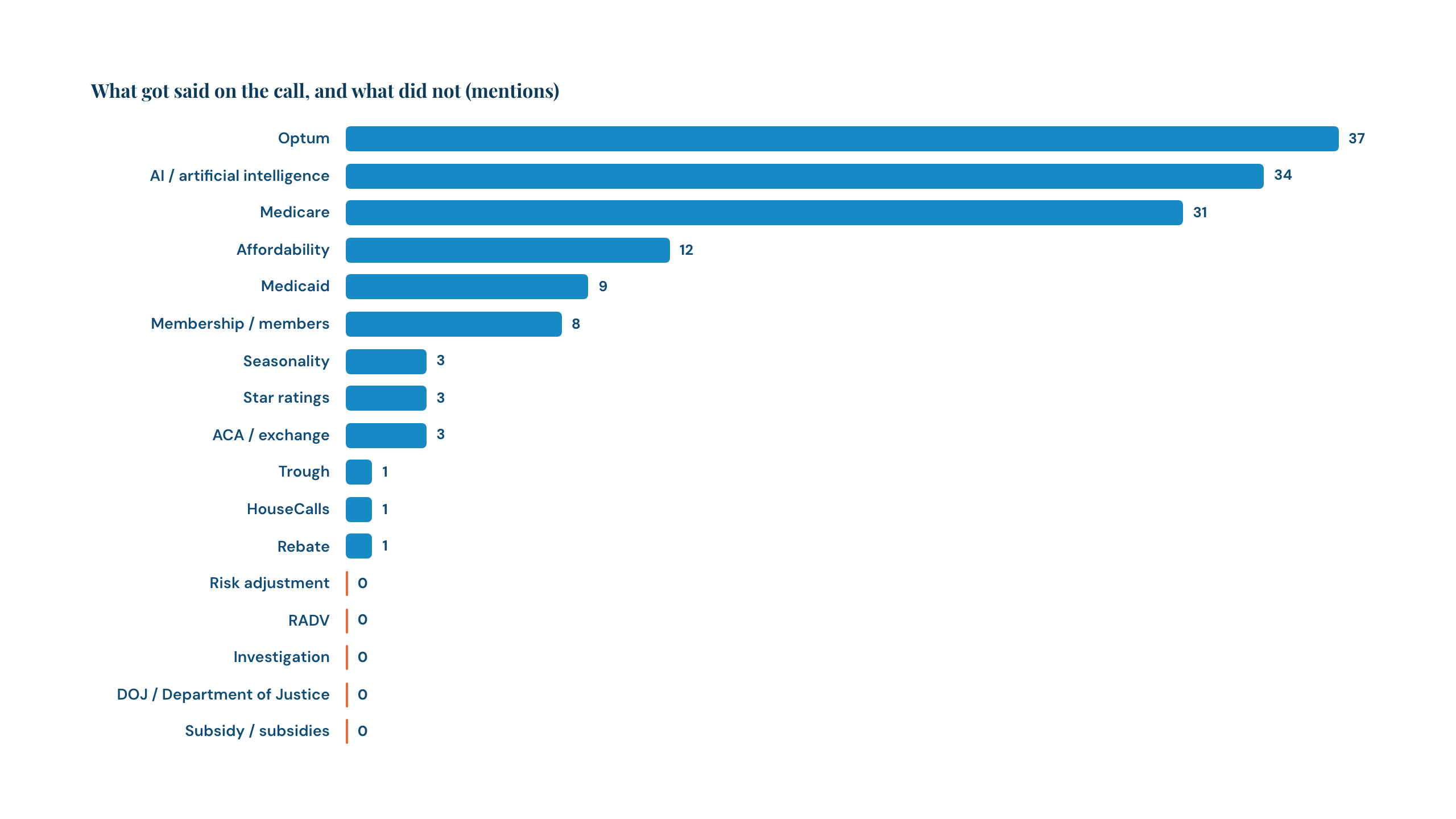
I counted every term across the full transcript, analyst questions included. This is the chart I would put in front of anyone who wants to know what a company chooses to talk about when it is climbing out of a hole.
"Optum" was said 37 times. "AI," or "artificial intelligence," 34 times. "Medicare" 31. "Affordability" 12. The word "membership," or "members," came up 8 times, which is to say UnitedHealth mentioned artificial intelligence more than four times as often as it mentioned the members it covers, in a quarter where it shed a net 525,000 of them.
Now the zeros. "Risk adjustment" was said zero times. So was "RADV." So was "investigation." So was "DOJ," and so was "Department of Justice."
UnitedHealth is under a Department of Justice investigation into its Medicare Advantage billing. It says so itself, in the forward-looking-statements section of the very release this call was about, which names "the DOJ's legal actions concerning our participation in the Medicare program" and "the application of risk adjustment data validation audits" as material risks. The same coding question cost Elevance a $935 million accrual a day earlier. Across ten thousand words, with a dozen analysts on the line, none of it was said out loud. The company spent part of its written release defending the HouseCalls program against exactly this line of scrutiny, and then went a full earnings call without naming the scrutiny once.
This is the same move Elevance made when it never said "subsidy." A live, material, dollar-denominated risk gets discussed everywhere except by name. The difference is that Elevance at least reserved against its version. UnitedHealth, on what it has disclosed, is contesting rather than accruing, which makes the silence louder. "AI" is what you say a company is doing. "Risk adjustment data validation" is what a company is trying not to have said about it.
What to watch
The second-half margin. The guide implies a medical care ratio near 91% in the back half against 85.3% in the first. If it lands softer than that, the full-year raise was conservative and there is another beat coming. If it lands there or worse, the first half was the seasonal high and the market rallied on the good half of the year.
The 965,000. UnitedHealth fixed its Medicare Advantage margin by shedding seniors. If the 2027 bids keep the book shrinking, this is a multi-year retreat by the largest MA carrier, and the counties it leaves are the story for everyone who covers Medicare Advantage participation.
The DOJ and RADV. Elevance accrued $935 million against its CMS notice. UnitedHealth is contesting rather than reserving, at least in what it has disclosed. If that turns into a number, it lands on the segment the company just spent a page defending.
The ACA rebate. "Eliminating and rebating profits" to about a million members is a commitment with a dollar figure attached that has not been printed yet. Watch whether it shows up as a real charge and how large it is.
The second raise, and whether there is a third. Guidance has gone up twice in 2026 off a 2025 base the company itself set too low. The interesting quarter is the first one where the comp is no longer a trough.
Sources: all company financials are from the UnitedHealth Group Second Quarter 2026 Earnings Release (July 16, 2026), including the income statement, the people-served and performance metrics, the revenues-by-business and earnings-by-business schedules, the balance sheet, the cash flow statement, the updated outlook table, and the non-GAAP reconciliation. Quotes are verbatim from the Q2 2026 earnings call transcript (Investing.com, July 16, 2026) and attributed to the executive who said them; where the auto-transcript's speaker tags were internally inconsistent, I used only cleanly attributed quotes. Term counts are case-insensitive matches across the full transcript text including analyst questions ("Optum" and "Medicare" count every mention of the word). The consensus figure (about $4.85 adjusted EPS) is a street estimate; the share reaction (a +7.6% premarket high of $450.36, closing +1.20% at $423.56 from a $418.52 prior close) is as reported by Investing.com. The MCR excluding favorable development (about 87.7%), the implied second-half EPS ($5.89 to $6.39), the implied second-half medical care ratio (about 91%), and the implied second-half operating cash flow (about $4 billion) are my arithmetic on the company's own inputs, not company-provided figures. As disclosed at the top, I own shares of UNH and have no intention of trading them in the next 30 days. This is not investment advice.